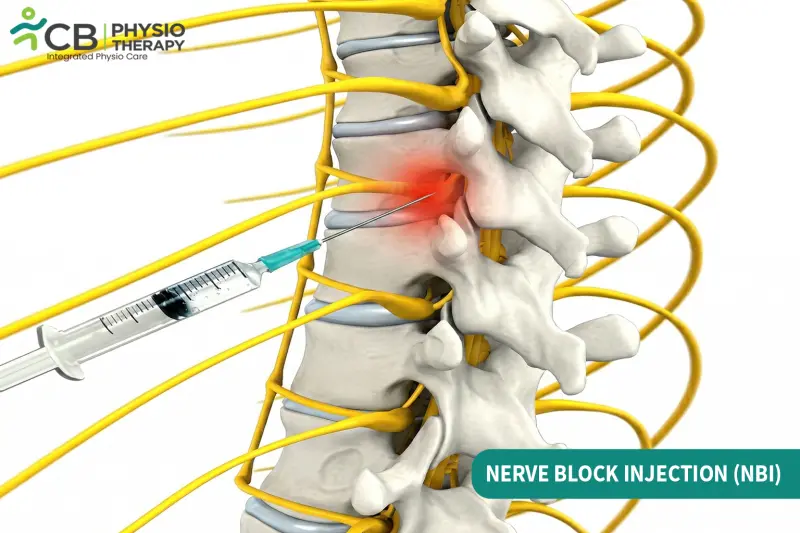
A nerve block injection is a minimally invasive pain management procedure in which medication is injected around a specific nerve to block pain signals coming from that nerve. It is used to diagnose and treat different types of acute or chronic pain.
The injection is given close to the targeted nerve under imaging guidance
(ultrasound or fluoroscopy).
Usually, one or more of the following medications are injected:
Local Anesthetic
Purpose:
- Temporarily blocks pain signals
- Provides immediate pain relief
- Helps confirm the source of pain (diagnostic value)
Corticosteroid (in some cases)
Purpose:
- Reduces inflammation around the irritated nerve
- Provides longer-term pain relief
Sometimes Neurolytic Agent (in special cases)
- Used for long-term pain control in cancer pain
- Destroys pain-transmitting nerve fibers (only in selected cases)
The anesthesia works immediately, while the steroid (if used) starts working within 24–72 hours.
To achieve both immediate and long-lasting pain relief, two medications are often combined in a nerve block injection. Each plays a different but complementary role in pain control.
- Immediate relief (anesthetic)
- Long-term inflammation control (steroid)
- Diagnostic + therapeutic benefit
Nerve blocks are classified based on the location and type of nerve being targeted. The choice depends on the source, severity, and pattern of pain.
- Peripheral Nerve Block – blocks a specific limb nerve
- Selective Nerve Root Block – targets a spinal nerve root
- Medial Branch Block – for facet joint–related pain
- Sympathetic Nerve Block – for CRPS or vascular pain
- Occipital Nerve Block – for certain headaches
- Trigeminal Nerve Block – for facial pain
A nerve block works by interrupting the transmission of pain signals from the affected nerve to the brain.
- Local anesthetic blocks sodium channels
- Prevents nerve impulse conduction
- Reduces pain perception
If steroid is added:
- Reduces inflammation
- Decreases nerve sensitivity
- Provides longer relief
Exact Procedure (Step-by-Step)
A nerve block is a minimally invasive, image-guided procedure performed under strict sterile precautions to ensure accuracy and safety.
- Patient positioned comfortably
- Skin cleaned and sterilized
- Local anesthesia applied to skin
- Needle inserted under ultrasound or fluoroscopy guidance
- Correct nerve location confirmed
- Medication injected slowly
- Needle removed and small dressing applied
Procedure time: 10–20 minutes
Observation time: 20–40 minutes
Same-day discharge
Many patients are anxious before the procedure. However, nerve block injections are generally well tolerated and cause minimal discomfort.
1. During Procedure:
- Mild needle prick
- Pressure sensation
- Temporary tingling or warmth
2. After Procedure:
- Immediate numbness in targeted area
- Temporary weakness (if motor nerve affected)
- Pain relief within minutes (due to anesthetic)
- Steroid effect begins in 1–3 days (if used)
The number of nerve block injections depends on the diagnosis, severity of pain, and how well the patient responds to the initial injection.
- Often 1 injection initially
- Some conditions require repeat injections
- Usually limited depending on condition and response
- Interval commonly 2–4 weeks if repeat needed
It depends on diagnosis and clinical improvement.
Yes, when performed under proper imaging guidance by a trained specialist.
Possible Minor Side Effects:
- Temporary numbness
- Mild soreness
- Temporary weakness
- Rare allergic reaction
Serious complications are rare when done properly.
The primary goal of a nerve block is to interrupt pain signals and reduce inflammation, thereby improving function and quality of life.
- Rapid pain relief
- Breaks pain cycle
- Reduces nerve irritation
- Helps confirm pain source (diagnostic value)
- Improves function
- Facilitates physiotherapy participation
Although nerve blocks are considered safe, certain medical conditions and situations may make the procedure unsuitable or require special precautions.
Absolute Contraindications:
- Active infection
- Bleeding disorder
- Allergy to medication
- No patient consent
Relative Contraindications:
- Uncontrolled diabetes (if steroid used)
- Pregnancy
- Severe systemic illness
Pain relief alone does not correct:
- Muscle weakness
- Joint stiffness
- Poor posture
- Movement dysfunction
After pain reduces, physiotherapy helps:
- Restore strength
- Improve mobility
- Correct biomechanics
- Prevent recurrence
- Achieve long-term results